Reading Time: 8 Min
You spend money driving traffic to your website—but most visitors leave without taking action. Why?
Conversion Rate Optimization (CRO) helps answer that question. It decodes real user behavior to uncover friction points, run experiments, and implement proven changes that lead to better conversions.
Let’s walk through how CRO actually works.
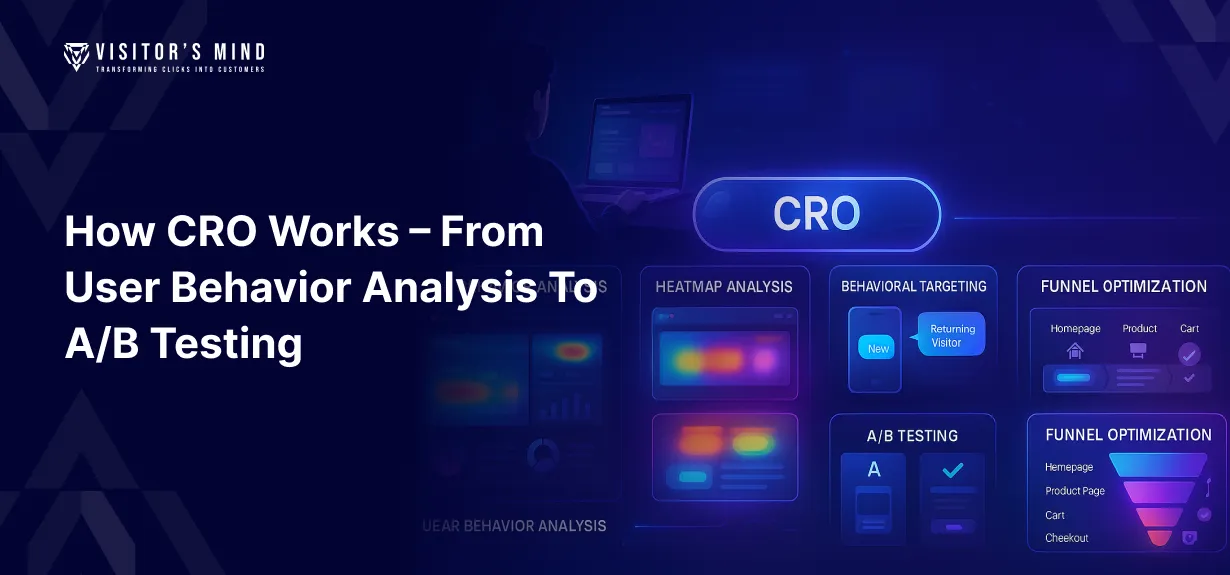
Think of this as digital detective work. We gather clues about what’s working—and what’s not—by studying:
- Session Recordings: Watch real users navigate your site. Are they getting stuck or confused? Example: Repeated clicks on a non-clickable element might indicate a poor UX decision.
- Event Tracking: Measure how users interact with key elements (like buttons, forms, or navigation). Know where they drop off or lose interest.
- User Journey Mapping: Understand the typical paths users take. Do they engage with blog posts but never reach the product page?
Example:
A SaaS brand found that users visited pricing pages but didn’t sign up. Behavior analysis revealed a lengthy, complex form. Simplifying it boosted conversions by 25%.
Heatmaps offer a visual guide to user behavior:
- Click Maps: Show which parts of the page get the most interactions.
- Scroll Maps: Reveal how far users scroll—key for understanding if your CTA is too low.
- Move Maps: Track cursor movements that correlate with attention or hesitation.
Example:
An ecommerce client discovered users clicking product images thinking they were buttons. We added a clickable overlay—resulting in a 30% increase in add-to-cart actions.
- Device Type (mobile vs desktop)
- Location (geographic personalization)
- Traffic Source (organic search, social, ads)
- User Status (new vs returning visitors)
Here’s where we get scientific. A/B testing lets us validate assumptions:
- Create two versions (A and B) of a page or element
- Split traffic equally
- Declare a winner based on real performance metrics
We test headlines, CTA wording, hero images, button colors—even form lengths.
Example:
A travel website tested “Book Your Dream Vacation” vs “Save 20% on Flights.” The discount-focused version increased bookings by 22%.
- Homepage: Communicate value instantly
- Product/Service Page: Highlight benefits, include social proof
- Cart Page: Simplify layout, reduce distractions
- Checkout: Minimize steps, offer guest checkout
In the early 2000s, digital marketers relied on gut instinct: “Make the button red.”
Today, CRO uses analytics, behavioral data, psychology, and AI-driven tools to make smarter, testable decisions. It’s not about guessing—it’s about evidence.
- Data-backed strategies
- Expertise in A/B testing, heatmaps, and UX
- A clear roadmap to higher conversions